Monday, March 7, 2011

Jerseylicious Style : Olivia

While there has been much debate and controversy over MTV's popular show Jersey Shore, about 8 twenty-somethings who live together in a house on the beach over summer, there has been little publicity about what I believe to be New Jersey's most entertaining show: Jerseylicious. Set in the Gatsby hair salon, it follows the personal and professional lives of all those who work there.


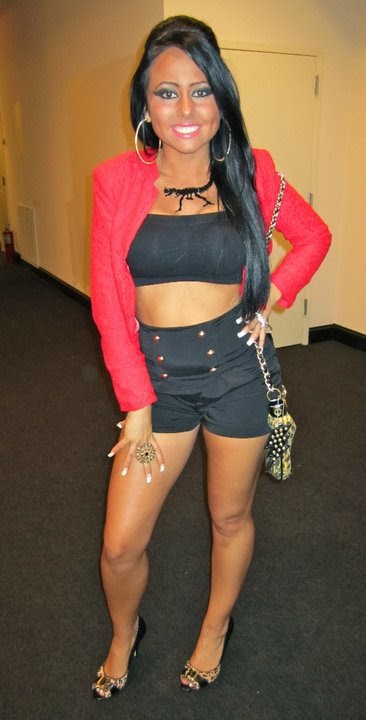
While the characters are very endearing and every show is entertaining the main reason I tune in is to see what everyone is wearing. With their style consisting of 'Orangina tans, long-nailed manicures, cleavage-baring fashions'. It is very different from anything I have ever seen before which is what makes it so fascinating. One of my favourites out of all the characters is make-up artist Olivia Blois Sharpe, seen below. Despite her over-the-top look, you just gotta love her. She is the cutest little person. lol. Here are some of my favourite "Olivia Looks".


I think her style is unique and definitely entertaining.
What do you think?

Sunday, March 6, 2011

Behind The Scene

You guys should definitely check out this video created by our friend, Melfin Jesmiel Salim from Sisleey.


 It was tiring but despite of that, we really had so much fun. Thoroughly a blast from the beginning until the end. FYI, Blast From The Past has just preparing a new collection, and will come out really soon next week. Go visit their fanpage on Facebook for more info.


nude loose crop-Djody , basic top & printed skirt-Pasar Senen, wooden wedges-Retail Therapy

Saturday, March 5, 2011

Racism in Fashion

This past week saw British designer John Galliano (pictured below) being suspended from Christian Dior, after an alleged anti-Semitic verbal assault by the Dior designer in a Paris bar. A video emerged of him ranting about Jews and women. "I love Hitler. People like you would be dead today," he tells two horrified women. "Your mothers, your forefathers, would be f***ing gassed and f***ing dead."


Fashion people everywhere rushed to check their hair before joining the chorus of dismay, almost as if racism and sexism were not the stock-in-trade of their industry. In fact, it is an open secret in high fashion that black and minority ethnic faces - alongside women whose ribs cannot be counted through their rattan tops, or "fat mummies" in the phraseology of Chanel's Karl Lagerfeld - are not welcome. The few working black models accuse fashion houses of declining to hire them on the basis of skin tone - model agencies recently suggested that perhaps consumers just don't like looking at black people.


Diversity in fashion is going backwards. The recent fashion week in New York, one of the most multicultural places on the planet, featured 85 per cent white models, a proportion that has hardly changed in a decade. French Vogue famously showcased white, Dutch model Lara Stone in blackface (pictured below), and when real black models do make it on to the pages of magazines, the airbrushing invariably lightens their colouring and straightens their hair into more marketable, Caucasian styles (see picture below). Then we wonder why anxious teenagers across the world are using dangerous toxins to bleach the blackness out of their skin.


What should shock is not just the substance of Galliano's comments, but the fact that it took a man being caught on camera explicitly saying that he loves Hitler for the fashion industry to acknowledge a teeny problem with racism. The rabid misogyny of Galliano's outburst has hardly been commented on because, while most people now acknowledge that anti-Semitism isn't very nice, the jury is still out on institutional sexism.

The misogyny of fashion culture, however, exceeds its apparent conviction that any woman with the temerity to do more than silently starve herself is abhorrent. Silent complicity surrounds the rapes and sexual assaults that are routine in the industry. When the designer Anand Jon was last year found guilty on 16 counts of rape and sexual battery of models as young as 14, the only surprise expressed by fashion insiders was that his victims had dared to come forward at all.

The pearl-clutching piety of the response to Galliano's ugly outburst is a primer in tasteful hypocrisy. High-profile fashion colleagues eventually expressed discomfort with his viewpoint, if that's an appropriate term for the sort of drooling monologue normally delivered by a park-bench pervert with two hands down his pants. The problem with racism and sexism in fashion, however, goes far beyond one slurring fantasist.

Thursday, March 3, 2011

THIS JUST IN


I just heard a rumor: Christophe Decarnin was fired from Balmain. If this is true, who do you think might replace him? Any ideas? After his A/W 2011-12 show, the only feeling I was left with was that it was time to move on from the same silhouettes and materials, but who could have possibly imagined...let's see what happens. I know for a fact, that many rumors have sparked after he didn't bow at the end of his show in Paris, but this one came from a trusted source...

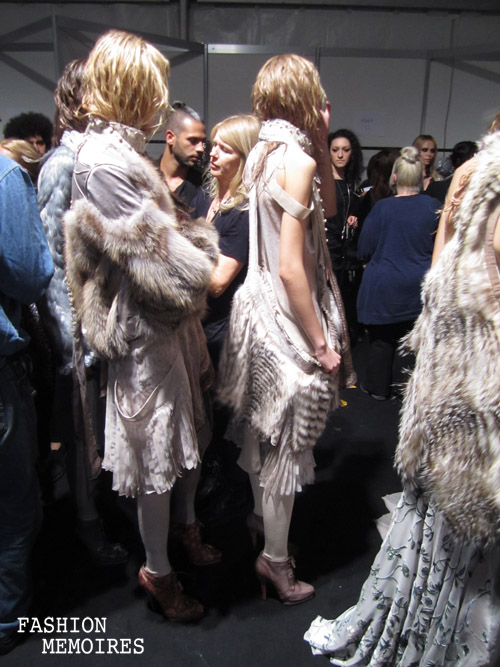
Enjoy The Last Of My Backstage Cavalli Diaries


Wednesday, March 2, 2011

Some More Pictures Backstage @ Cavalli


Era of the Fashion Blogger

There�s no doubt that fashion blogger�s are shaking things up in the fashion industry. Spring 2010 marked the first year that fashion bloggers were invited and welcomed openly by designers to sit on the front row of major fashion shows. Bryan Grey-Yambo, better known as �BryanBoy� was seen sitting just two seats away from the all-powerful Anna Wintour, Editor of American Vogue at the Dolce & Gabbana Spring/Summer 2010 collection (pictured below).


Their presence has produced a mixed reaction within the international fashion industry. To editors, fashion blogger�s presence is a painful reminder of the changing times and the democratising power of the Internet. One could say that the Internet has opened up doors for everyone to be a critic. But to fashion bloggers, like myself, it�s a blessing, and a chance to be heard. Nevertheless, the fashion blogger�s presence is another example of fashion�s modern evolution. Fashion has always relied on operating under exclusivity. And to be more specific, the trickledown effect � meaning the fashion elite (high-end designers, luxury brands, wealthy style icons, etc.) set the trends that would eventually �trickle down� to the masses in the form of lower end goods, which often result in the fashion elite no longer finding those trends desirable. Fast-forward, and the fashion industry, much like the society that surrounds it, has changed drastically.


These changes can be seen in a few isolated developments including The Style Network, Fashion TV, and shows like Project Runway, and the Rachel Zoe Project. The emergence of fashion bloggers is next in the biggest series of changes. Until recently, only fashion editors held the key to publication influence. Month after month, consumers purchase magazines and sift through trend lists and styled spreads that have all been selected by powerful editors and top stylists. But fashion bloggers have been offering an alternative. That alternate is essentially what the public wants. Fashion bloggers are not necessarily stylists or aspiring designers or even models. I have a BA Degree in Fashion Design, but essentially I�m just like the next person. I have an opinion, and I just happen to love everything that is fashion. These are qualities that appeal to the down-to-earth nature that consumers want to achieve.


Naturally this creates a situation. On one hand, you have the use of fashion bloggers on the front row, which creates a larger market and more exposure for designers, and sometimes that exposure is reciprocated, like Marc Jacob�s BB Ostrich bag in honour of Bryan Boy. This relationship between designers and bloggers was once exclusive to only the fashion elite. Not so anymore. Like some situations, this one ends with a posing question: Should the fashion industry continue to open up-be even more accessible to the public, or should the industry try to retain some air of exclusivity? Change is inevitable for the fashion industry. Being an industry that revolves around change, innovation, and reinvention, it does have a hard time dealing with changes within its own infrastructure.